AI in Language Learning: A Complete Guide
A practical guide to using AI for language learning without falling for hype: feedback, personalization, explanations, and smart practice loops.

AI didn't invent language learning. It just made two things cheaper: feedback and practice.
Used well, AI helps you learn faster because you can ask questions in the moment, generate practice on demand, and get explanations that match your level. Used poorly, it turns into an expensive way to feel busy.
What AI Is Actually Good At
1) Explaining meaning in a way that fits your brain
Dictionaries are precise. AI can be personal. It can explain a word using examples from your context, contrast it with close synonyms, and warn you about common mistakes.
2) Generating practice that targets your weak points
Practice is what builds fluency—but creating good practice takes time. AI can generate fill-in-the-blank questions, rewrite sentences, and produce quick drills around the exact words you keep forgetting.
3) Evaluating open answers (not just multiple-choice)
Real language isn't a multiple-choice test. AI can evaluate meaning: “Is my definition close enough?” “Is this sentence natural?” That's where learning becomes usable.
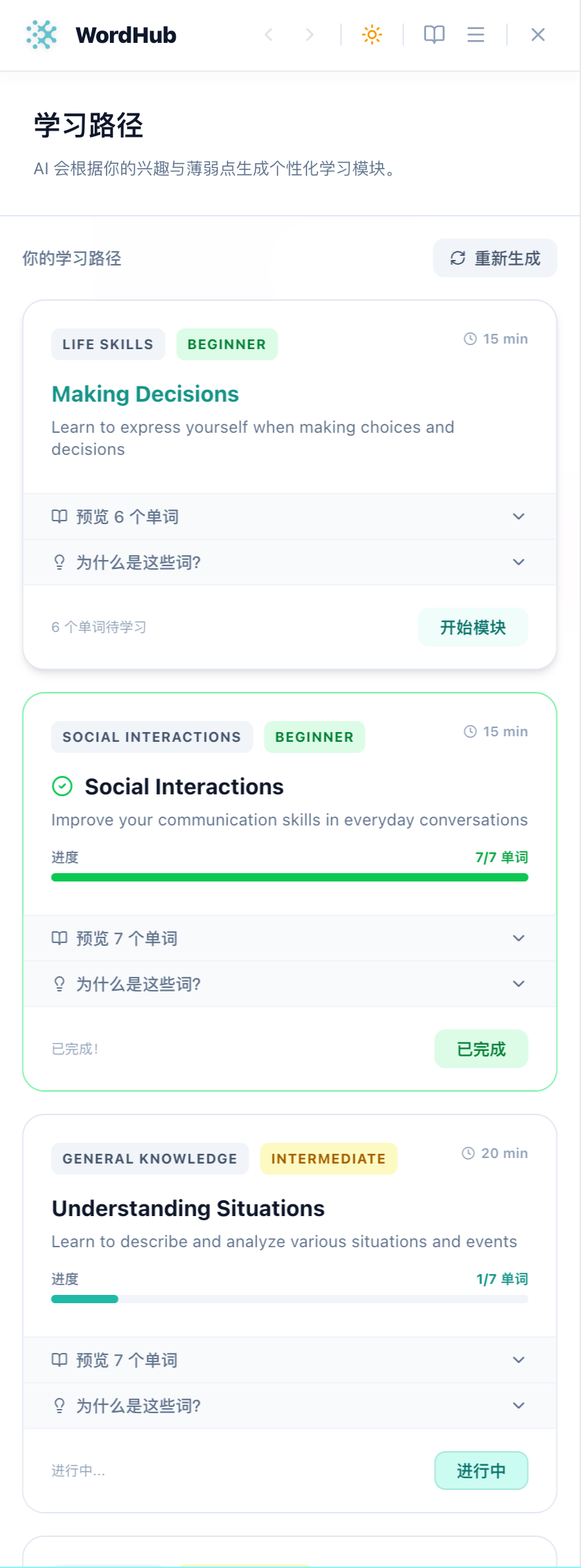
4) Personalizing learning paths
A good study plan should reflect what you read, what you care about, and what you keep missing. AI can take your vocabulary history and suggest thematic modules that fit your goals.
What AI Is Bad At (And How to Avoid the Trap)
1) Being reliably correct
AI can be wrong in a confident voice. For vocabulary, that matters. The rule: use AI to explore meaning, but confirm with a dictionary when it's important.
2) Replacing input
No tool replaces real reading and listening. AI is an assistant, not the gym. The “training” still comes from input and recall.
3) Making you passive
If AI gives you the answer instantly, your brain doesn't struggle—and without struggle, memory doesn't form. Use AI to create retrieval, not to avoid it.
The Practical AI Loop (Read → Ask → Practice → Review → Reuse)
Step 1: Read something real
Start from input: articles, research, news, work documents. Vocabulary from your life sticks harder than vocabulary from a random list.
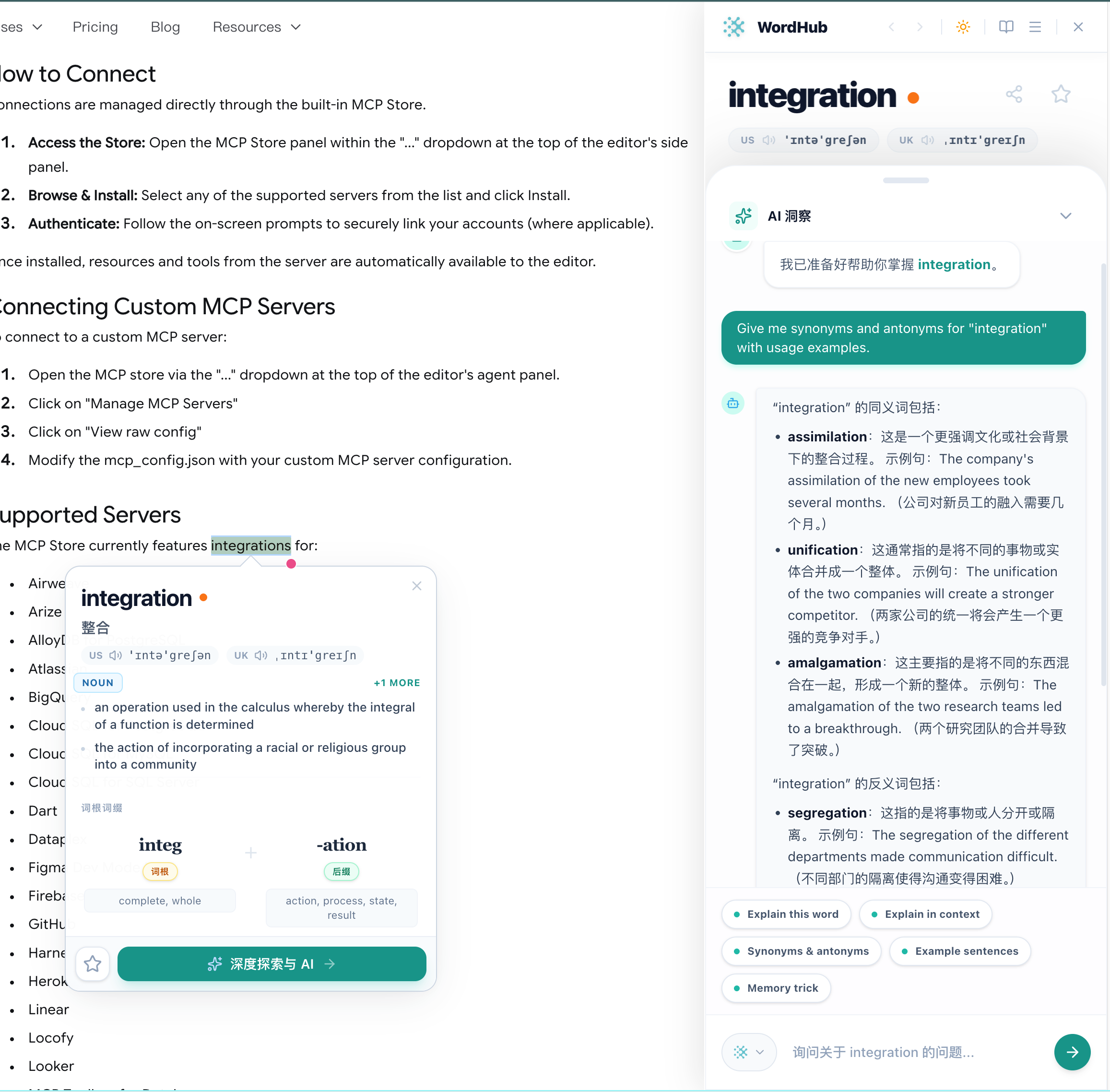
Step 2: Ask “the right questions”
Instead of asking “what does this mean?”, ask:
- “What's the difference between X and Y?”
- “Give me 3 natural example sentences for my field.”
- “What collocations should I learn with this word?”
- “Explain it like I'm B2 / C1.”
Step 3: Generate practice (but keep it short)
Ask AI to generate 5 questions, not 50. You want momentum, not overwhelm.
Step 4: Review with spaced repetition
AI makes practice cheaper, but spaced repetition makes practice effective. Review words on schedule so they don't leak.
If you haven't read it yet, pair this post with How Spaced Repetition Revolutionizes Vocabulary Learning.
Step 5: Reuse the vocabulary
Your goal isn't to recognize the word; it's to use it. Every week, pick 10 words and force them into your writing or speaking. AI can help you polish sentences—but you should write them first.
How WordHub Uses AI (Without Replacing Real Learning)
- Embedded AI chat: ask about a word while you're reading and get explanations, examples, and contrasts.
- Learning path generation: suggest thematic modules based on your saved vocabulary and interests.
- Quiz evaluation: semantic checks for open answers (definition / fill-in-the-blank), so recall stays real.
AI becomes powerful when it sits inside the real loop: you read something meaningful, you capture the right words, and you review them on time.