How Spaced Repetition Revolutionizes Vocabulary Learning
Spaced repetition fixes the real problem in vocabulary learning: forgetting. Here’s how it works—and how to use it without burnout.
Most people don't “fail” vocabulary because they aren't smart enough. They fail because the brain does what it's built to do: forget things that don't come back.
Spaced repetition is the simplest fix I know. Not because it's magical—but because it respects timing. It brings a word back right before you lose it.
The Problem: Vocabulary “Leaks”
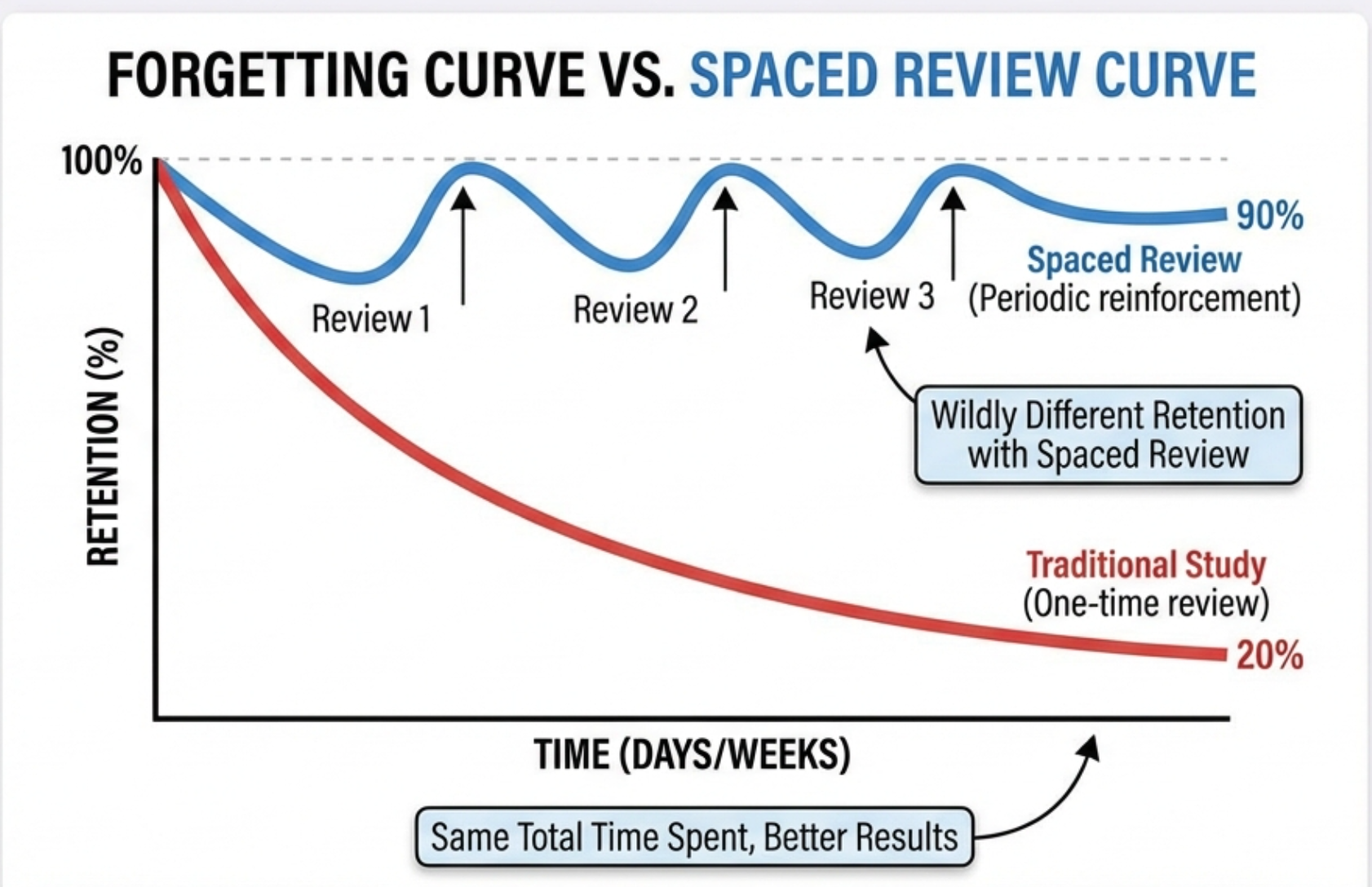
If you learn 30 new words today and never see them again, you didn't build a vocabulary—you built a temporary memory. That's why people constantly feel like they are “starting over.”
The solution isn't more willpower. The solution is a system that makes old words return automatically.
What Spaced Repetition Actually Does
A spaced repetition system (SRS) does two things:
- Schedules reviews: words you're likely to forget come back sooner.
- Uses retrieval: you try to recall, not just reread. That effort is what strengthens memory.
WordHub uses an SM-2 style scheduler—the same family of logic used by classic SRS tools. Under the hood, each saved word keeps a few simple fields:
- Ease factor: how “easy” the word feels (hard words grow slower).
- Interval: how many days until next review.
- Next review date: when the word is due.
SM-2 in Plain English (Why It Works)
Here's the intuition: if you recall a word successfully, the gap before the next review grows. If you fail, the word comes back sooner.
In WordHub's implementation, the early pattern looks like this:
- First successful review: 1 day
- Second successful review: 6 days
- After that: the interval multiplies by the ease factor (hard words grow slower; easy words grow faster)
- If you miss it: interval resets small so the word returns quickly
The result is strangely comforting: your daily queue stays small, but your long-term retention grows.
Why Spaced Repetition Beats “Weekend Marathons”
Marathon study sessions feel productive because you see a lot of content. But memory doesn't care how long you sat in a chair. Memory cares whether you recalled the word after time passed.
Five minutes daily is “small” in the moment and massive over months.
How WordHub Turns SRS Into a Habit
WordHub pairs SRS with a real-life workflow:
- Capture: look up a word while you're reading, then save it with the sentence and page source.
- Review: the daily quiz pulls words due for review so you don't have to decide what to study.
- Progress: mastery levels rise as you recall consistently.

One detail that helps: quizzes aren't only multiple choice. WordHub can evaluate open answers (definition / fill-in-the-blank) so you practice real recall—not just recognition.
Common SRS Mistakes (And the Fix)
1) Saving too many words
If you save 50 new words a day, your review queue will eventually punish you. Save fewer, review better. A good number for most people: 5–12/day.
2) Saving words without context
“Word → definition” flashcards are fragile. Saving the sentence + source gives your brain an anchor. It feels like a memory, not a quiz.
3) Skipping retrieval
Rereading is comforting. It's also weak. If you can answer without looking, your brain rewires. If you can't, the scheduler adjusts and the word returns sooner.
The Simple Rule That Makes This Work
Keep your system small enough that you don't avoid it. Your future vocabulary is built by the habit you can still do on tired days.
If you want the most practical version of this idea, pair spaced repetition with real reading: save words from articles you actually care about, and let the scheduler do the boring part.