The Complete Guide to GRE Vocabulary
Stop collecting random “hard words.” Build GRE vocabulary in clusters, learn what the test actually rewards, and make the words stick.

There's a moment every GRE student hits: you open a word list, see abstruse, obdurate, execrable, and realize you're supposed to learn thousands of these… while also improving quant, writing, and stamina.
Here's the good news: the GRE doesn't reward vocabulary hoarding. It rewards precision, tone, and relationships. If you learn words as a connected system—not a pile—your accuracy climbs faster and your review load stays sane.
What GRE Vocabulary Really Tests
Vocabulary questions look like “word knowledge,” but what they actually test is whether you can reconstruct meaning under pressure.
- Precision: choosing the one word that fits the logic of the sentence.
- Tone: recognizing attitude (approval, skepticism, irony, optimism).
- Relationships: spotting synonym pairs and contrasts fast.
That's why learning isolated definitions rarely transfers to points. The GRE asks: “Do you recognize the shape of meaning?”
The GRE Vocabulary Map (6 High-Yield Clusters)
Instead of a single list, build clusters you can recognize quickly. When you learn clusters, you get both vocabulary and test intuition.
1) Approval vs Disapproval (evaluation words)
GRE passages love judgment. Learn words that signal positive/negative evaluation.
- Positive: laud, extol, commend, admirable
- Negative: denounce, deride, disparage, contemptuous
2) Certainty vs Doubt (stance words)
Many questions hinge on whether the author is confident or cautious.
- Certainty: unequivocal, conclusive, definitive
- Doubt: dubious, tentative, equivocal, ambivalent
3) Change vs Stability (movement words)
- Change: transform, alter, deviate, mutate
- Stability: consistent, immutable, steadfast, entrenched
4) Argument verbs (how ideas fight)
These verbs show up everywhere because GRE passages are basically debates.
- assert, posit, contend, concede, refute, corroborate, undermine, bolster
5) “Difficult people” adjectives (tone + character)
- obdurate, intransigent, pugnacious, truculent, recalcitrant
6) Precision connectors (logic in disguise)
These aren't “vocabulary list words,” but they drive Text Completion logic.
- nevertheless, notwithstanding, conversely, consequently, albeit
Word Families Beat Word Lists
GRE vocabulary isn't just “knowing the word.” It's recognizing the word in different forms:
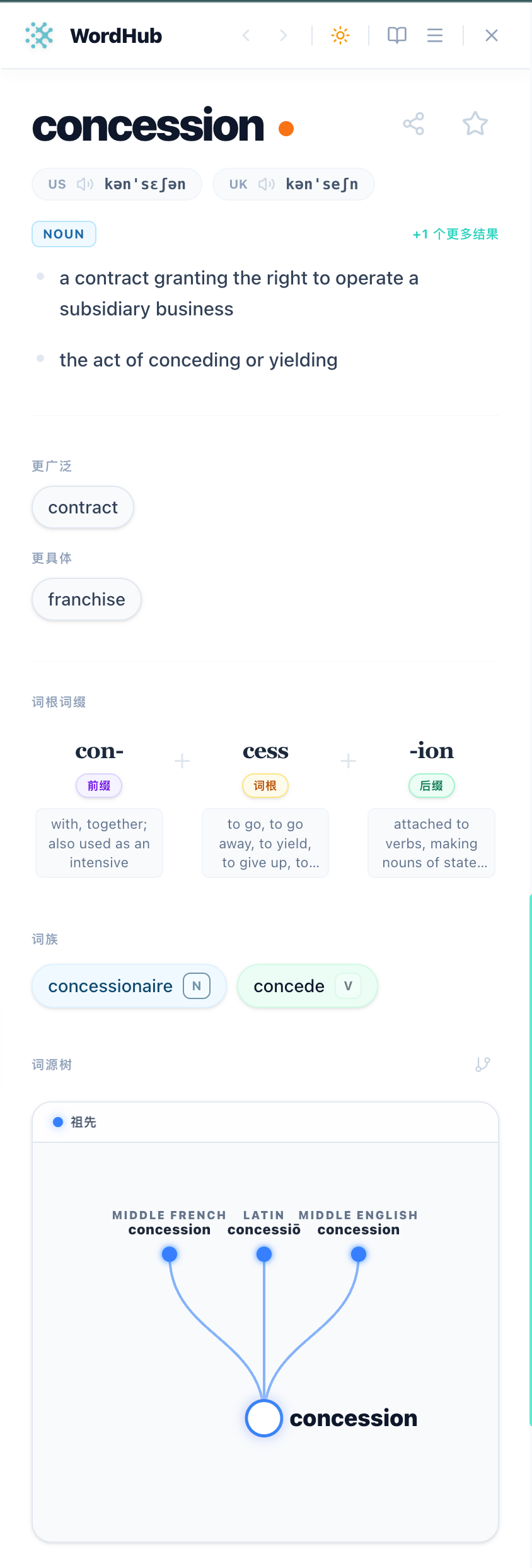
- concede → concession
- obdurate → obduracy
- ambivalent → ambivalence
- corroborate → corroboration
This matters because test passages won't politely use the exact form you memorized.
Roots, Prefixes, and the “Free Points” Strategy
When you don't know a word, the fastest rescue is word parts. A surprising number of GRE words become guessable when you can spot common roots and prefixes.
- -cred- (believe): credulous, incredulous, credential
- -dict- (say): verdict, contradict, benediction
- -voc- (call): advocate, equivocal, provocative
- in-/im-/il-/ir- (not): immutable, impassive, illicit, irreverent
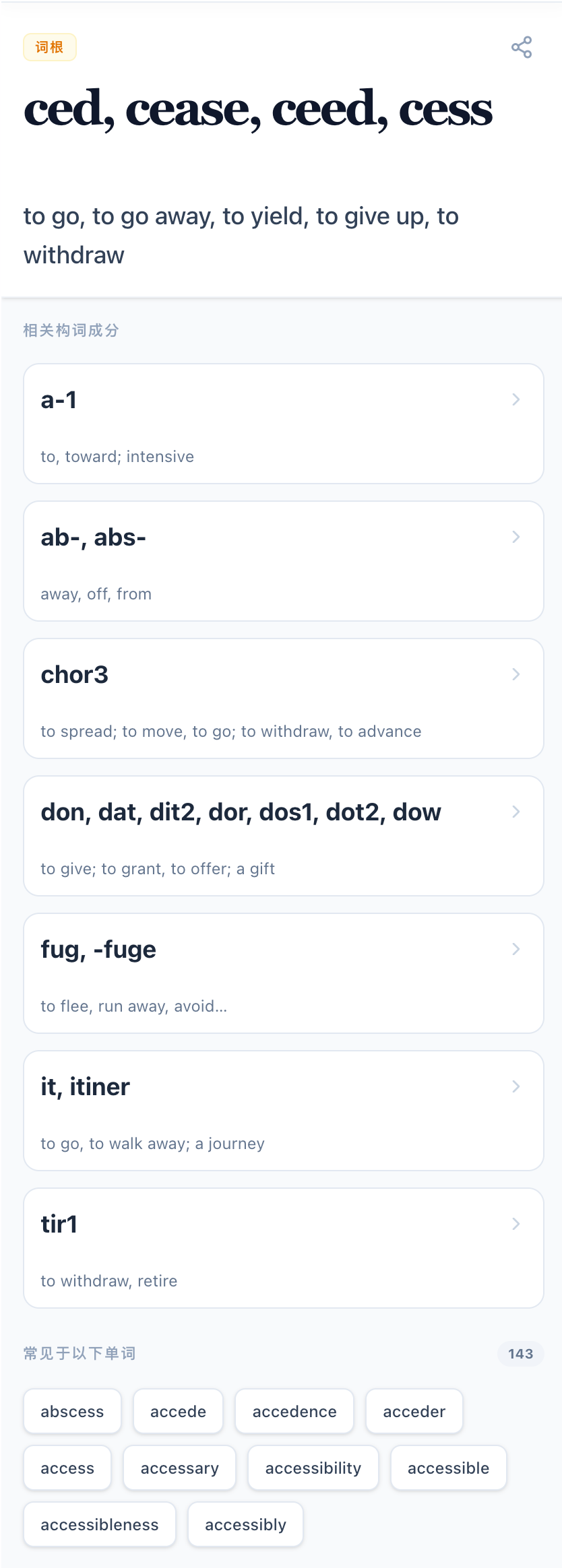
WordHub can surface word breakdowns and root families, which helps you learn patterns—not isolated definitions.
The 3-Phase Learning Method (That Survives Busy Weeks)
Phase 1: Capture words in context (15 minutes/day)
Read something dense enough to contain GRE-like language (essays, high-quality journalism, academic writing). Use fast lookup and save only the words that matter.
Phase 2: Review on schedule (5–10 minutes/day)
Spaced repetition is where the gains compound. A small daily review queue beats weekend marathons because it keeps words alive in memory.
Phase 3: Convert vocabulary into points (2 sessions/week)
Practice Sentence Equivalence and Text Completion with a focus on synonym pairs, contrast cues, and tone. Every missed question is a vocabulary opportunity.
A Practical 8-Week Plan
| Weeks | Focus | Daily Habit |
|---|---|---|
| 1-2 | Build capture momentum | Read 15 min, save 5-8 words |
| 3-4 | Start daily review | Review 5-10 min, add synonym pairs |
| 5-6 | Timed practice + error vocabulary | Save words from mistakes |
| 7-8 | Refine + stabilize | Review, drill weak clusters, full-length tests |
Want the “Do This Every Day” Version?
This guide is the map. If you want a step-by-step workflow specifically built around WordHub's features (Page Scan, Reading Mode, daily quiz), read How to Prepare for GRE with WordHub.
GRE vocabulary becomes manageable the moment you stop trying to learn “everything” and start building a system that you can repeat even on tired days.